

Dr. Liz Wayne, host of the Office Hours podcast, is joined by Dr. Michelle Oyen, Associate Professor of Biomedical Engineering at Wayne State University, for an in-depth discussion on pregnancy through an engineering lens. Oyen shares how biomechanics, materials science, and data analysis are transforming our understanding of pregnancy, from placental development to preterm birth—the leading cause of neonatal mortality worldwide. Together, they explore the mechanical properties of the amniotic sac, how environmental factors like atmospheric pressure can influence birth outcomes, and why pregnancy remains one of the most understudied areas in medicine. The conversation highlights both the challenges of researching pregnancy and the powerful role biomedical engineering can play in advancing women’s and maternal health.
Office Hours: Episode 6

Pregnancy as an Engineering Process —
A Conversation with Dr. Michelle Oyen
.svg.png?width=39&height=39&name=Podcasts_(iOS).svg.png)

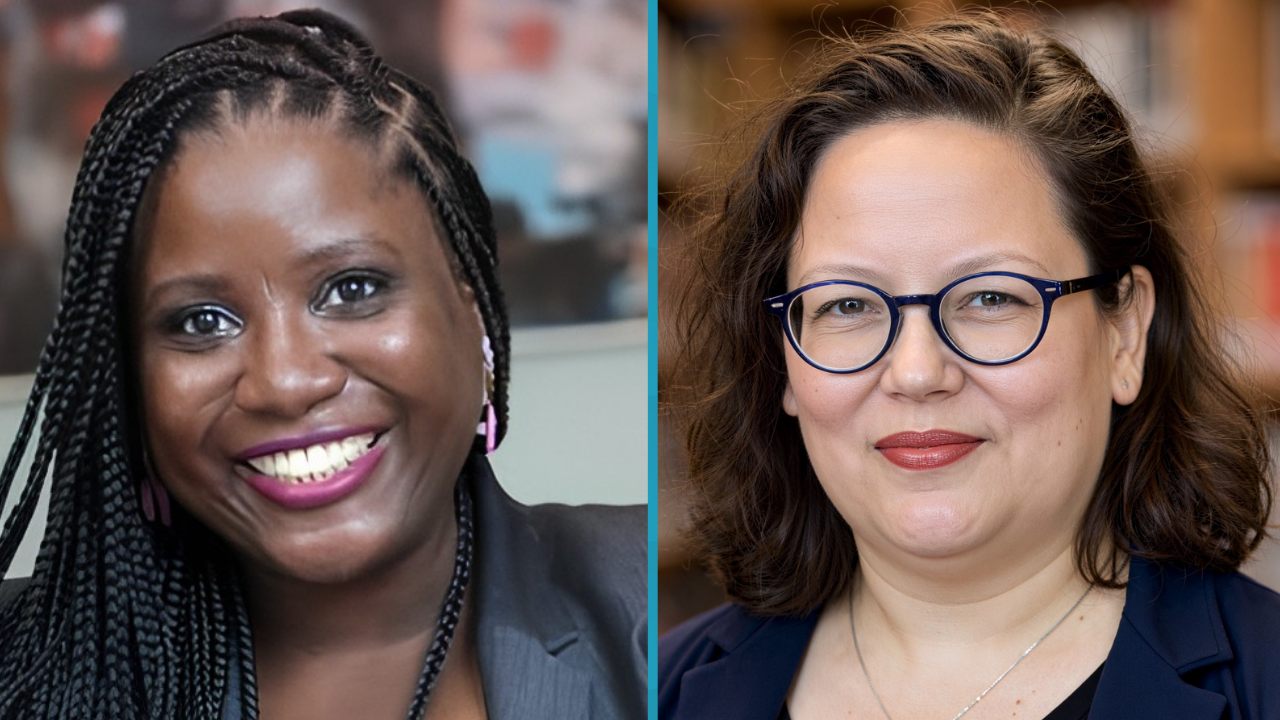
Dr. Liz Wayne, Office Hours Host & Assistant Professor at University of Washington; Dr. Michelle Oyen, this month's guest, Assistant Professor of Biomedical Engineering at Wayne State University
Episode Extras
-
Learn More About Dr. Michelle Oyen
Dr. Michelle Oyen is an Associate Professor in the Department of Biomedical Engineering at Wayne State University in Detroit. She began her faculty career in the UK at the University of Cambridge (2006–18). She returned to the US in 2018 and was briefly at East Carolina University and Washington University in St. Louis. Michelle has degrees in Materials Science and Engineering (BS), Engineering Mechanics (MS), and a PhD in Biophysical Sciences. She has worked on many problems in tissue biomechanics and biomimetic materials. She has researched engineering approaches to pregnancy and women’s health for over twenty-five years, particularly in methods to prevent, diagnose, and intervene in preterm birth. Current research projects include multi-scale modeling of placenta transport function, microstructural fracture models of uterine-placental interface delamination, and developing digital twins of C-section scar pregnancy. Michelle is a leader in organizing the women’s health and engineering community both in the U.S. and globally revention, progression, and prognosis.
Links to Dr. Oyen's Work
As Mentioned on the Episode
-
Read the Transcript
[Music]
Liz Wayne: Hi everyone and welcome to the office hours with Liz Wayne, a brand new podcast brought to you by the Biomedical Engineering Society. I'm Liz, an assistant professor in bioengineering, and I'm going to introduce you to the world of biomedical engineering through my eyes or my voice. From genes to machines, biomedical engineers can do it all. We'll dive into how discoveries are made, how research becomes medicine, and what it's actually like working in academia today. So, whether you're a student, researcher, educator, or just someone who is curious about science and how the academic world works, you've come to the right place.
Welcome, we're in another session of office hours. I'm Liz Wayne, your host, and I am so excited to tell you about things that I've been learning because it's office hours, and that's what we do in the office hours podcast with academics who can't help but explain things even when they're off duty. So, we have with us a special guest. Her name is Dr. Michelle Oyen, so I don't know if you knew this, or maybe, I mean, why would you know? There's lots of people who may not know, in 2024 I did some of the best tissue engineering of my life. I had a baby, and it was amazing as an experience, right? That I didn't really know I was going to do, and then I did it, and then I got really scientific about it, and I was thinking about like, how I've seen all people trying to make organs and, you know, tissue on a chip, and making new joints and implants and all this fun stuff. And so I thought, I look at my belly and go, like, ah, what kind of like cellular composition, matrix deposition, and like forces and cytokines and immune cells and everything is being perfectly timed. And how is it? How did all of that go into making this giggly baby boy, and I have no idea, and apparently the tissue engineers don't either, but we would like to think that we do for most of my life and my training. I really can't tell you how I did things, but I can tell you why I had the feelings that I did, or I can tell you like that I experienced something, and I'm really curious about how it is that people go through something so frequently, such as childbirth, right? And we're all teaching engineers, but we don't really know how we did it, but then we understand the process so poorly. And then maybe there's another psychological thing in here, which maybe you can help me with, because why do we need to understand everything? But that's another topic I need to understand.
Okay, so I have a special guest with us who specifically knows or spent her whole life trying to think about how the engineering principles can be applied in pregnancy, and how that influences all the things from the minute scales to the large scale at the end early stage versus end stage. Dr. Michelle Oyen is an associate professor in the Department of Biomedical Engineering at Wayne State University, and you've actually had several places where you've done school. But before I get into kind of like school and like how you learn things, I'm really curious about what you would say in your words, what you study, and why?
Michelle Oyen: Yeah, so I study preterm birth, pregnancy, stillbirth, basically things that go wrong during pregnancy, things that we don't understand why they go wrong. Because actually, that's one of the things that you find out as soon as you start studying pregnancy, is how very little we actually know about it.
Liz: Yeah. So you went to studying what goes wrong? How often do things actually go wrong?
Michelle: Far more often than they go right. We don't know. I mean, this is actually part of the fascinating thing about this. We don't know, because a lot of people miscarry before they even know they're pregnant. And so we suspect that somewhere between 30 and 50% of all pregnancies fail very early, and then you have ones that make it through the first trimester. But then they can fail, and they can fail in different ways. You can have stillbirth, where the fetus dies in utero. You can have preterm birth, where the fetus comes out long before it should. Lifetime morbidity possibilities, preterm birth is now the leading cause of neonatal mortality, and that's actually changed during my career. So when I first started doing this, infectious disease still was the leading cause of neonatal mortality, and now it's preterm birth, because we've actually done a pretty good job of handling infectious disease, and we still don't understand anything about pregnancy.
Liz: Yeah, you know, I actually did have complications during my pregnancy. Surprise, surprise. And I was always interesting how there was a mix of people both saying, like, complications are so normal to people in maternal fetal medicine that they weren't always alarmed the way I was. Or, you know, the way that we thought about things was more like, let's get you, let's see if you can carry long enough to get to, like, you know, 22 weeks to where we can get something done, like viability, right? Yeah. But this is interesting, and I'm really curious about your perspective on these things. Because thinking about engineering, you know, a question that I would think about was when I was talking about, you know, tissue engineering, and how this is the best tissue engineer I've ever done. But I had no idea what I was doing. But in a way, you could, you also think of pregnancy, actually, as an engineered process, like a natural engineering process?
Michelle: Absolutely. You know, it starts in such a simple form, right? You have a fertilized egg, so you have a single cell, and it starts to divide, and it immediately starts to build the infrastructure that it needs for a successful pregnancy. So in fact, not a lot of people realize this, but the very first cell divisions that happen in the first cell differentiation that happens is actually formation of the placenta, because the placenta is fetal tissue, and that is what's going to keep the baby alive during pregnancy, that's what's going to be the interface between the mother's body and the fetal body. And so that is actually the first thing that starts to develop. And in fact, during the first trimester, the embryo itself is tiny and the placenta is growing. And then after the first trimester, you eventually start to get to the point where there's been a lot of cell differentiation within the embryo, and then it starts growing, and it starts to outpace the placentas growth. But early on, you have really a lot going on with the placenta while the embryo is still tiny and just barely starting to form.
Liz: Yeah, so, and what you're describing, really is, you know, if we thought about, how do you make a building, and there are certain steps that happen, and there's a sequence of events, and then some happen first, and then there's an overlap, and then there are engineering constraints and size and shape, and there's all these responses. And it's kind of interesting to think about how our body - like we're all engineers here, kind of making these multi step, multicellular, multi organizational events happen. And so, I think that's a useful perspective maybe to have as we think about why people don't know or understand how much can go wrong in pregnancy. Because if you don't think of it as an engineered process, or a process that has multiple stages, it can be challenging to think about like the right framework, where you can envision, well, when one of those doesn't happen at the right time, or, you know they're not- Cell one is continuous with Cell two, then you know the building would fall, right? But so would, you know the pregnancy.
Michelle: That's a perfect analogy for things that go wrong when you have complications that show up late in pregnancy, like in the late second or early third trimester, like preeclampsia, like fetal growth restriction. Those are things where the poor foundations of placental development happened back in the first trimester, but you don't realize it. And so it's exactly like you're saying that maybe we didn't build the foundation properly of the building. And then we get up to the 20th story, and suddenly we realize, oh, the foundation's not sound. And so now we have a problem up on the 20th floor that happened all the way back at the very beginning in the foundation. And so that's actually something that I think is really interesting about studying the placenta, is that you can have these things that go wrong early. They don't show up until much later, and then when they do, they can be very serious for both the fetus and the mother.
Liz: I see. And so this is also making me think we should take a step back, maybe, and just define a few things for our Office Hours. So, I was going to say, what is pregnancy? But maybe describe the stages of pregnancy and just very basically, so that people, when we say terms later on, maybe they'll understand what we're talking about.
Michelle: Absolutely, I don't think a lot of people know very much about the very earliest stages of it. So the vast majority of the time, the egg meets the sperm somewhere in the fallopian tube or the uterine tube, it then has to travel, and it takes more than a week to get from there down into the uterus. So, in fact, even though you have the fertilization, the egg meeting the sperm, that doesn't actually get to the point where that is implanted into the uterus itself for somewhere between seven to 10 days. And in fact, that fertilized egg starts dividing, but as it's dividing, it's moving down the uterine tube towards the uterus. It has to go the distance of about 10 centimeters, which, if you think about it, for teeny, tiny little cells, that's quite a long distance. And so, it then gets down to the uterus. And then, once it's at the uterus, what it has to do is implant into the uterine wall. So. Endometrium is the lining of the uterus, and that becomes decidualized. So, it turns from endometrium, which is like the normal state of the non-pregnant tissue, into decidua, which is the pregnant state. And so, you then have that little tiny ball of cells now, because, of course, 10 days have gone by, and so it's been dividing that whole time. So now you have that first differentiation has happened, and you've got cells that are going to form the placenta on the outside, and the cells that are going to form the fetus itself on the inside, and that little ball of cells then has to invade into the uterine lining to implant. And so now you have the cells from the mother's uterus interacting directly with the cells from the embryo, some of those embryo cells, and this is the part that I find just crazy, even after decades of studying this. Some of those cells from the embryo actually leave the embryo and go into the mother's tissue and start to remodel her blood vessels in order to essentially prepare the placental bed.
Liz: And that's supposed to happen?
Michelle: And that's supposed to happen, and if that doesn't happen well enough, then you can have problems later in pregnancy. So in fact, those earliest stages of pregnancy are extraordinarily complicated and very difficult to study, because there are no good animal models of human pregnancy. And so this has essentially been a black box, which is why we know so little about it. Until recently, when we could do things with stem cells and trying to make some sort of in vitro or microfluidics ways to study these things, we had no way of knowing how this actually worked.
Liz: Right again, is this recalling? I did not even - I wouldn't even know I was pregnant at that point, and then I was like, didn't know all these interesting intricacies are happening. And I'm happy that you mentioned microfluidics, because this is a bioengineering technique where we try to make things on the small scale that can better mimic the physiology that we have. So, if we have- if our vessels are 100 microns or smaller in size, and we need to make things that are that small so we can understand how things transport through them. And so I think when people think of pregnancy, as you mentioned, they don't think about the stages, or maybe that is more of an orchestrated engineering sort of event. But I bet people also don't think that it's a mechanical right? So I'm curious, because you know, you have a background in biomechanics. How did you start thinking about pregnancy as a biomechanical interaction or a process?
Michelle: This is actually a true story. I was a graduate student, and I was studying tissue engineering of cartilage so very clear mechanical osteoarthritis
Liz: Cartilage like the matrix that make up bone?
Michelle: That makes up the joints. So at the ends of the bones, you've got cartilage in the joints, and so the articulating surface is cartilage on cartilage, like in your knee or in your hip. So I was studying that, and I actually took a cold call in the lab, and it was from an obstetrician, and he said, is there anyone there who knows how to measure forces? And I said, I know how to measure forces. I'm doing that right now because I was testing some tissue engineered cartilage. And he said, I have a problem that I think needs to be studied in terms of the forces. And what he was interested in was premature rupture of the amniotic sac, or premature breaking of the waters. Okay, when somebody, you know, they're in a movie and they're standing in an elevator and all of a sudden they say, oh, my God, my shoes are wet. I think my waters just broke. It's a physical, mechanical rupture of the amniotic sac. And so, he and I then started collaborating, collecting pieces of amniotic sac from pregnancies and pulling on them to measure the forces it took to break that membrane.
Liz: Whoa, what? A cold call, and you were just there?
Michelle: I was just there in the lab, yep.
Liz: And so then you were breaking water all the time, then. That's wild. What did you find?
Michelle: Well, so we were specifically trying to study whether betadine, the antiseptic, could weaken the fetal membranes, and so we were taking strips of the fetal membranes, which actually come out attached to the placenta. So, after the baby's born, in the final stage of labor, the placenta is born, and the fetal membranes that are still attached to the placenta come out. And so we could collect strips of this tissue from real pregnancies, from humans, and we were taking half of them and putting them in betadine antiseptic to see if that antiseptic was weakening them, and then comparing that to controls that were just sitting in saline, and so we did not find a difference in the strength. It did not seem to be that the betadine was changing the strength of the membranes, which was good because there are certain medical procedures that the doctors do where there might be some betadine that gets on the fetal membranes when they're looking at somebody who's got cervical insufficiency, where the cervix has started to open prior to full term. And so that was the concern. The concern was when they were doing a procedure to try to stitch the cervix closed, which they literally do, they sutured the cervix closed. We're trying to see whether that getting antiseptic on the fetal membranes during that procedure could cause them to weaken. And we found that, no, it did not. And so that was really good news.
But that was my first study on pregnancy, and this was when I was in graduate school. This was the late 1990s, so quite a while ago now, and then that, just doing the literature review for that very first paper, I started seeing, wow, this is clearly a biomechanical process. There's barely a literature on this, although there were a couple of papers in the literature, including one going all the way back to 1867 there were not that many. And so, this was something that had just kind of gone past biomechanical engineering, but was clearly a mechanical phenomenon, since rupture is failure, is, you know, mechanical failure of this amniotic sac. So, this kind of drove my interest, seeing that there was so little out there, I thought, well, actually, this looks like a great career direction. Cartilage is very crowded as a field, but boy, nobody's studying pregnancy.
Liz: Wow. And I'm curious, like, how firm was it? Because I imagine it doesn't have to be pretty tough stuff, yes. And that's what the beautiful thing about biology, because I imagine that this needs to be strong enough to uphold the force of, like a growing baby just pushing on it, and then you're also moving all the time, and you're bending and stretching, and so, like, you don't want to have a baby because you took a poop, right? But I imagine it also, like properties that need to also have, like fluid, like wet, maybe, like some stickiness, so that things, it needs to be impenetrable, but I guess there is some sort of nutrient transfer that can happen. And so, making a property, you know, that's tough and strong, but also soft and sweet and delicate, that's like, that's crazy, and that's what it needs to be.
Michelle: It is. And in fact, that's why we've been so interested in this particular tissue, the amnion layer of this amniotic sac. It's two layers. It's got the chorion layer and the amnion layer. And the amnion layer is extraordinarily stiff and strong. So elastic modulus on the order of 10 megapascals and strength on the order of one megapascal. I mean, when we talk about tissue engineering, we're usually thinking about kilopascals. So, we're like a factor of 1000 down from that a megapascal is very similar to a rubber band. So in fact, this material is very, very comparable to rubber in terms of its properties and it's much stiffer and stronger than a lot of the other tissues in the body, like the tissues in the uterus itself are much, much, much lower than that. But this membrane that's around the baby, and that's holding the baby, the placenta, the amniotic fluid, all of this, it has to be, as you said, extraordinarily stiff and strong.
Liz: So I mean, it has to break eventually. And so what does make it break?
Michelle: So we started collecting this material from births that happened at all different gestational ages, and from pregnancies where a person had a traditional vaginal delivery versus a C section. And what we found is that actually the strength of this membrane starts to go down about 30 weeks' gestation, and it sort of trends downward, so it's actually starting to get weaker as you get closer to a full term pregnancy, and at the same time, the stress in it is going up, because the amniotic fluid pressure is going up. And so in fact, there's kind of a crossover point where that stress and strength are equal, and that, under normal circumstances, is at about full term, which is 40 weeks of gestation. But in fact, we've shown that in some cases, like if, for example, you're in a situation where you're in a hurricane and the atmospheric pressure is very low, you could actually see that shift happening such that you would predict preterm birth. And that has been documented that people have preterm births during hurricanes.
Liz: That's crazy. I was actually going to ask you about this, because I saw, like, you had a paper that you wrote, and it was like, hurricanes can affect preterm birth. And I was like, what could this be? And I think it's interesting, because my first thought would have been something like, oh, everyone's just really stressed out. And, you know, like, you're just like, there's an emotional cortisol, you know thing happening, but you're saying, No, this is mechanical. This is just like nature. This is atmospheric pressure. This is purely mechanical, which is crazy to me in an interesting way. Tell me more.
Michelle: So the best data on this actually comes from Japan, where they also have hurricanes, and they have tracked and looked at the rates of preterm birth as a function of storms. And they basically have plotted preterm birth rates as a function of the atmospheric pressure, because when you get a hurricane, the atmospheric pressure goes low. And so you have a positive atmospheric pressure in the fluid, in the uterus, inside the amniotic sac. And so the difference between that external pressure and the pressure inside the amniotic sac becomes greater, and it becomes great enough that it could actually burst that membrane.
Liz: Whoa. Well, that is insane. So they must have similar studies about people who live at higher altitudes or low altitudes.
Michelle: And so that's a great point. They do a lot of studies, particularly of women in the Andes, but all of their physiology is adapted for living at high altitudes. And so everything about their pregnancy is a little bit different. And so in fact, that's a huge area of research within pregnancy research is sort of women in the Andes trying to understand different physiological adaptations, because you have all of these different components, right? You've got the placenta, you've got the amniotic sac, you've got the amniotic fluid, you've got the fetus itself. But then you have other adaptations, like women who are pregnant, their blood volume goes up by about 50% so you actually gain a huge amount of blood during pregnancy. And so that's another thing where you know, when you're at a high altitude, a lower atmospheric pressure, you get all of these other physiological adaptations that are different. And what really is a problem is, if somebody who's physiologically adapted to being at lower altitude then goes to high altitude, right? It's when you go through a change that there can be a problem. Women who live at high altitude are physiologically adapted to living at high altitude, and their pregnancies have some differences compared with people living at sea level. But they are used to it, essentially.
Liz: You know, this is reminding me so some people who are pregnant often like to have, like a honey(moon)- what's it called? A baby Moon occasion. It's like their last hurrah before they stop traveling. Because there's, you know, people say, stop traveling 28- some, some amount of time. But the challenge is, is that there actually end up being a lot of people who get stranded because they travel to a different place, and they have a complication that forces them now to stay in place, they can’t travel to their hospital, their care. And so I was talking with someone who knew about this, in Hawaii, there is a huge problem, like, women will go to Hawaii for their baby moon, and they end up staying there. I guess it's a very common thing to them, right? Because everyone wants to go to their them as a destination, and then, lo and behold, like Surprise, surprise, they have some complication they weren't thinking of, and now they have to. They're stranded there. They, are they, you know, you spend 10s of 1000s of dollars or more because you're the hotel cost. And, yeah, so that was really interesting to me. And the other thing I wanted to say, when I was pregnant, I made a very active choice to turn down and a visit. I was going to go to Colorado School of Mines, and I remember, because, you know, like, normal me, like, Yes, I'm so excited. I would love to come and talk and start, you know, talk science. I was like, wait, what altitude is this? And then, you know, and I talked to a few people, and they're like, Yeah, you know, if you were like, Week Six or, like, something first trimester, probably would have said yes, but you're like, 20, you know, and it's high altitude. And, like, I knew that high altitude would not be good for me because of the low oxygen, and especially with someone with preexisting conditions, it just really wasn't, I mean, it wouldn't have been a good idea, I think, for even someone without those conditions. But it was a concerted effort, because I knew about high altitude and differences and changes that could happen during pregnancy for someone who's not acclimated to that.
Michelle: Well, I mean flying, flying when you're in your third trimester is maybe not the best idea. I mean atmospheric pressure on an airplane these days is controlled a lot better than it used to be, but it's still... is it worth the risk? I don't know. A lot of airlines in Europe are very strict about not letting people travel during their third trimester, or especially not later in the third trimester. I was with a friend once going to a conference, and she was pregnant, and they wanted a doctor's note to say that she was okay to fly.
Liz: Yeah, I got grounded because so actually, I don't mind sharing, but I was one of those cervical insufficiency people at 20 weeks, like, it was like, 4 million something. The number was not good. And I knew that because, you know, I thought, like, oh, look, everything's fine. And then, like, they do, like, oh, wait, hold on. You know, they gotta do, like, the conference in the background. They're like, actually, you can't go home. You got to go to the triage upstairs. Like, what? And then. You know, they told me it was happening, and they're like, Yeah, your cervix is open and it's not supposed to be and so they were worried about, you know, if it keeps opening you pre term birth and it's not going to be viable. And so then they said, okay, so be calm. But also, and don't do anything, but also, don't not do stuff, right? Because now they used to do bed rest and do nothing. And now they realize that bed rest is not actually beneficial, but you don't have really good criteria for telling people when they should and should not do things. And so they would just say, like, just don't do any cervical exercise. And I was like, so I get it, don't ride a bike. But like, should I not bend down? Like, what? What do you want me to do? Don't get stressed. And then so I ended up canceling all of my trips because I had a like, you know, it wasn't third trimester. I was trying to get out my last conferences, because then they said, well, the risk now is that if something happens and you're not in your city, like, are you going to be taken care of? And so we just want you to be close to your doctors in case something happens. And then, yeah, well, they're like, also, you're just trying to make it a 22 weeks minimum. We want to get more, but at least 22 or 24 depends on what hospital you're at.
Michelle: Did they put you on antibiotics.
Liz: They gave me progesterone and like a suppository, progesterone, to try to strengthen the wall. They gave me the choice of a cervical CERCLA or the index, but they, I guess, the data, I had very research oriented people in my care team, and they were very much like, it felt like a 50/50, in terms of the benefit based on the data of which one's going to work, and like where I was, and the outcomes, you know, didn't, weren't as clear. And then that's really interesting point about research, and maybe there needs to be more. And also I was thinking about how everyone wants to rely on the study, but it's also really hard to get those studies done in the peer reviewed, formal way.
Michelle: especially in pregnant women. So all pregnant women are vulnerable populations, so you immediately have to- the barriers to doing clinical research with pregnant women are higher than for other women, right off the bat. And so, it's, you know, a sort of precautionary principle. It's a completely reasonable thing that we don't like to do experiments on pregnant women, because we learned the hard way with things like thalidomide, right when thalidomide was actually available over the counter to prevent nausea, and that led to limb loss and a lot of stillbirths and preterm births. And so ever since thalidomide in the 1960s, which actually was never approved in the US. So that was in Europe that that largely happened. There was a wonderful woman, Francis Oldham, who was working for the FDA, who was unconvinced that this was safe in pregnancy, and she essentially single-handedly, blocked it from getting approved in the US. And sure enough, they discovered that if people took thalidomide during a certain part of the pregnancy, it led to malformation of limbs. And so you have an entire generation of people in Europe who have missing limbs, essentially because of thalidomide. And ever since then, we have been almost, I don't want to say too cautious, but we've been so cautious that there have been very little new advances in pregnancy, in terms of drugs, medical devices, all of that. There are some new things being developed now, including, you know, particularly for the case of insufficient cervix, because there's a lot of interest in that as a problem. But there have not been a lot of things approved for the use in pregnancy for a very long time, and that's partly because of the fact that we're very cautious with pregnant women, but it's also partly because of the fact that we don't have an animal model for human pregnancy.
Liz: Yeah, and so I want to shift the conversation and talk more about models and engineering, but I was thinking, the consequence of not having the studies and relying on them is that a lot of knowledge is peer to peer, or like this center. So in other words, one center will say, we know this isn't approved, but we've had enough women in our center that have, let's say, not discontinued their medicine that they needed before pregnancy, and we know it turns out fine, even though this one study says it may not be. And they go and the study isn't- you know, sometimes the study isn't powered enough. When I say powered enough, I mean, they did the best they could-
Michelle: Not enough numbers, yeah.
Liz: with a special population, or they saw it in a rat, but like, if they didn't really see it right? So there's, like, some gray area, but they feel beholden to the result. But also, hey, our clinic sees this all the time, it's okay.
Michelle: But this is actually a really exciting area of pregnancy research right now, because, of course, this is a natural experiment that happens. You know, typical number of births in the United States per year is 3.6 million. If you start doing medical records reviews, you have big data that you can do machine learning. And so actually, there have been an increasing number of studies where people have actually just gone into medical records and looked at, you know, what kind of over the counter prescription medications were people taking during pregnancy, and now you can get studies that are powered enough, because those medical records during pregnancy are very detailed. And so, it's a data mining problem, and this is actually something that I think is very exciting. So there's many reasons that I think engineering has a lot of really exciting opportunities in pregnancy research and data is one of them.
Liz: So you have this publication in Science Advances, and you talked about harnessing data in pregnancy, and how, again, you mentioned pregnancy or natural experiments. And so, tell me more about this data and, you know, this is another interesting part about being a busy biomedical engineer is to find these different tool sets, and data is also a tool. So tell me about this journey to like, realizing that if you can't get the right pregnancy model, use the natural experiments from the data.
Michelle: Absolutely and I think this is the future, because I don't think that we can do enough clinical studies prospectively to answer all the questions about pregnancy that we need to answer, right? I would say, as a researcher, pregnancy research is decades behind other areas of medical research, and so we need to catch up. And our way to fast forward is to harness all of this data that's available, to harness these natural experiments. The place where this is really happening right now is overseas, because in the United States, we have a fragmented health system. You go to, say, a Scandinavian country, or you go to Israel, which is where the study was in the paper you just mentioned, they had taken basically medical records for 800,000 pregnancies in Israel, and they had full data on those pregnancies, including all of the sort of routine physiological measurements that were taken both before the pregnancy, during the pregnancy and after the pregnancy, and they essentially zeroed them all out at the time of birth, and then averaged all of those measurements and compared controls to cases where people had a pregnancy complication. And so they were able to see patterns in this huge data set. And even more excitingly, they made that data set available. So, in fact, I downloaded it so I can play with it myself. And so I think not only is it really important that we harness this data, but we make it open source, so that everybody can benefit from it. And this is, I think, a really exciting thing in pregnancy research.
Liz: What's the closest thing that we have in the US? Would it be like? Well, I was going to say Medicare, Medicaid, or-
Michelle: that's a really good point. Yeah, so about just over 40% of births in the United States are on Medicaid. So in fact, that is our largest single source of data. But there's also things like, there's a company that does what's called synthetic medical records. So, they'll actually go into a hospital system, and they will basically recreate the data while keeping its population characteristics. So it'll keep its averages and standard deviations and things, but it's completely anonymized, so you don't have any issues with privacy, which is always, especially in women's health, we worry a great deal about privacy when we're talking about reproduction, and so that is one of the big concerns, always, when you're talking about harnessing these huge data sets. It's what are we doing about the privacy of women, especially women from marginalized communities, because that is a major issue with pregnancy research in the US.
Liz: I'm thinking about the fact that you said that we're especially worried about privacy for pregnant women. And I'm curious what the- maybe you could just like explicitly say what those concerns are that people have.
Michelle: Well, at the moment, we know that a lot of pregnancies do not succeed, and there has been a political trend towards blaming women if those pregnancies don't succeed, so the woman must have done something wrong. And of course, this is a real problem, because a lot of things can go wrong in pregnancy, and they are not anyone's fault, yeah. And so, this has been a real challenge thinking about, how do we make sure that we're not blaming women for a failed pregnancy just because they're going about living their life during the time that they're also pregnant? It's, you know, it's about 10 months of the year that you're pregnant. It's a long period of time to, you know, worry about what kind of cheese you're eating, or there's so many environmental factors that you could consider. There's so many things that you could consider. I mean, even just simple things like driving a car, women who are pregnant are more likely to get in car crashes than women who are not pregnant. And there is the potential for seat belt injuries. I mean, this is something that we study from a biomechanical perspective, because it's really important that cars were not only not designed for women, they were definitely not designed for pregnant women. And where do you think the seat belt goes, right across the pregnant belly. So, you know, we have to think about these things.
Liz: Yeah, that's a- thank you for bringing it up. It’s such a super important point that I didn't think about immediately. But it is very true. And it goes back to, I'm doing this tissue engineering. I have no idea what I'm doing. I didn't really know when I started, but even now, I will still look back and go, Oh man, like, for instance, I really craved root beer at the end, for some reason. I was so conflicted, because, you know, I was worried about, like, what it would mean to satisfy my urge and just guzzle, like, six root beers a day when that's so much sugar. What am I doing to my child, like, diabetes, you know, all this stuff. And I was just worried, if I do this, am I affecting him in some way that's going to have a downstream consequence, like that idea that everything you do, if you don't sleep, if you sleep too much, if you don't walk enough, if you don't drink enough, did you take your medicine? Go eat that food, you know, and make sure it's the right food. Even though I just want a root beer, I don't know why I want six root beers, and I want them right now. So, yeah, yeah, there's so much pressure. And especially if someone can go back and go, like, look, this is why you did this. I'm suing you, or I'm making your insurance, or whatever the case might be. It's really interesting. So, in your science advances paper, I mean, I had a quote here, and it was like about half the tests take on the order of months to a year to return to baseline after delivery, highlighting the physiological aftermath of pregnancy. And I think this is an interesting perspective, because anecdotally, I heard, I mean, it really does feel like once the baby's here, like, yeah, the baby's here!
Michelle: It’s over! (laughs)
Liz: And actually, it’s not done.
Michelle: No. And in fact, that's why we count maternal mortality any time a mother dies, up to a year after giving birth. And in fact, that's why Medicaid expansion to cover that first year post birth has been such an important change in the United States just in the last couple of years, because pregnancy is kind of like a stress test for your cardiovascular system. If you don't realize that you have cardiovascular disease, you might have problems during pregnancy, and not only do you then have a higher risk of cardiovascular disease for the rest of your life, but the fetus has a cardiovascular risk that's higher for the rest of their life. And I think that's a really important point about pregnancy. This is not just about women's health. This is about human health, because what happens when you are a baby in utero, things that are going on with your mother physiologically during the pregnancy can affect you for the rest of your life, whether you're male or female, and so cardiovascular disease in particular can happen in that first year after the baby's born, because your system doesn't fully recover from the cardiovascular strain of the pregnancy, and then you do still have an elevated risk for the rest of your life, if you had, say, high blood pressure during the pregnancy itself.
Liz: That's such an important point, and I think having that data is useful to illuminate that, because, again, you can't really do that research. You would be hard pressed to find me in the streets doing a survey postpartum. It's not where I want to be. But it seems like a really interesting journey that you're going through from applying these basic biomechanics principles thinking about pregnancy, and how they fit complications, or when things go wrong, and then, oh, we need to experiment. So do this. Wait. We're not going to get all the experiments. Very sensitive population, hard to find models that really replicate this using data. And I also like that you brought up that your models don't just come from the US, but you sometimes in these natural experiments, you can find ways to study things by studying people live in different populations which might have different either dietary or like different exposure to climate and so. And I bring this up to you because you because you also spent some of your career being a researcher in different countries, right? And so, you were in the in the UK for a while.
Michelle: Yes, I spent 12 years in the UK before I came back to the US. So, I went over there after my postdoc, and I was there for 12 years. And then I came back to the US about seven and a half years ago now.
Liz: Okay, that's great. You lost your accent.
Michelle: (Laughs) I don't know if I picked one up. I still get- people say I sound different, and I think it's more word choice. I use different words because of having lived in British English for a long time.
Liz: I see. But what was it like doing research in other countries? I'm curious.
Michelle: I mean, having started out studying fetal membranes when I moved to the UK, I didn't realize that at the University of Cambridge, where I landed, they had the leading center probably in the world for placental research. And so that's where I started doing placenta research. And it was just one of those things where I have this, like, infinite source of collaborators and opportunities. And so, I started studying placenta and started studying, really, you know, transport of oxygen and nutrients from the mother to the fetus. And, you know, really getting into that. And again, it's an engineering thing, right? You're talking about diffusion, you're talking about blood flow. This is absolutely an engineering problem looking at the placenta, but it hadn't really been thought about that before. It's mostly been looked at from a cellular and molecular biological perspective. And so we've built models of trying to understand oxygen diffusion and blood flow, and how that happens in the placenta, in both healthy and unhealthy placentas. And that's turned into a major part of my research now. And it's thanks to the fact that I was just, you know, by virtue of being in the UK, where the placental research has been excellent, and where they had a very large group of people who were studying this. I just kind of got exposed to it and saw all of the engineering opportunities, and again, just kind of jumped into the research field.
Liz: Yeah, I think the undertone of what you're saying too is so one, it's always important to be in a space that has other researchers who are interested, that have now accumulated the infrastructure, so their resources, like, whether that's financial institution, equipment, the tissue, and then also, I'm also going to read into this and say that it seems like having a society then that values women's health and as a study, and maybe even like their attitudes towards the research have made, made that more easy to do, whereas I think the US is probably still catching up. The US is catching up on research in maternal spaces, both in terms of their value and thinking it's worth doing it, but then also, which then allows scientists to ask those questions, which require funding, models, tissues that are available.
Michelle: Yeah, and all you have to do is look at the NIH budget and see how little of it has been devoted to women's health over the last couple of decades, and realize how big of a problem this has been, and it's been really gratifying the last couple of years that there's been a lot more attention on the fact that women's health has been understudied, under resourced for a long time, but it's not necessarily getting fixed right now, and that's something that is interesting. You know, being in the women's health space, we have different funding sources than just the federal government. There's a lot of different ways of doing research in this field than the traditional ways. And I think it, you know, affects your research. It affects your career progression, because it's not, you know, there's not a great funding stream, especially for an engineer. There's not like an existing funding stream for studying pregnancy. From an engineering perspective, it requires being a bit scrappy.
Liz: Yeah, very scrappy. So, the climate definitely helps. And you know, I would argue that pregnancy is so pervasive in the sense that, like, we all got here somehow, and people are thinking about, like the birth decline and all these things, but valuing studying this helps keep people alive, keep people sane throughout and so it's very important to society. And I'm curious, because this is a topic that is both pervasive and also not as talked about. How do you engage with the public about your work? What does that look like for you? It's a lot of landmines, right?
Michelle: There are. There are a lot of landmines, but I also think it's more important than ever to be shining a light on some of these topics. And in fact, it's why I do things like this. Do a podcast. I accept every opportunity that I have to speak to the general public, whether it's through, you know, public radio, I've done a bit of documentary TV. It's like any opportunity that I have to try to shine a light on this and how poorly we understand pregnancy and how much of an impact it has on society, I just feel like it's gone under the radar and that people don't always know. And when I say to people, 10% of births are preterm. And 21,000 babies are still born in the US every single year. Like these are big numbers. This is a large financial burden to our health care system that we don't know and understand why babies are still born, why babies are born preterm. We just do not know enough about this and only concentrating focus on the care phases of medicine and not doing the basic science research that leads you to have mechanistic understanding of what's actually happening and why things are going wrong. This is a real fault in our overall understanding that we need to fix in order to improve the lives of families, of babies, of parents, because it's devastating to have a preterm birth. It's devastating to have a stillbirth. I work with some of the mothers who have had this happen to them, and they are so passionate about what they do, and in fact, it's changed the overall direction of my career a little bit that I spend a lot more time thinking about public engagement and outreach and greater society, not just what's happening in my own lab with the very detailed research that I'm doing.
Liz: You know, as an example for if there are other scientists who are listening, how do you engage people in your work?
Michelle: Well, I've been very lucky in that I've managed to meet a set of women who have had stillbirths through the work that I've done. So, we've had a major research project for the last three years about stillbirth, and I managed to get linked up with some of the stillbirth mothers. And there are some fantastic articles that have been written about this. ProPublica has done a whole series on this. There was a documentary film that came out, I think, last year about stillbirth and about in particular, one of the stillbirth mothers who's been trying to get some legislation passed through Congress to increase study of stillbirth. And she's somebody Deb Haynes, she's somebody that I've talked to a lot, and I can get you the link to that movie. You can actually watch the movie about her trying to get this through Congress. And kind of it goes through a couple of other stillbirth mothers, and you know how that affects them in a subsequent pregnancy? Because, of course, it's a big emotional thing. If you have a stillbirth and then you become pregnant again, it's very scary.
Liz: Yeah, I think after you have a miscarriage, your perspective changes, or the stillbirth, or trying to get pregnant, even, and all the reasons why that can be challenging, right? It's so very so it's very good. And I'm so excited to hear that you talk with other people, and I personally have found, when I engage with people, that my research may center around it. This feels more purposeful.
Michelle: Yeah, absolutely.
Liz: But you also get good ideas too, you know, like, research questions or ideas of like, oh, we should study that. And like, Wait, not it should be studied, but like, maybe I should,
Michelle: We should do it.
Liz: Yeah, right. We should study together. Maybe I can write that grant. I can go talk to people. I can present that meeting, you know? And it's so empowering in a moment where you might feel powerless. This is super exciting.
And all right, and we're back. What would a world without biomedical engineering look like?
Michelle: A World Without biomedical engineering would look like women giving birth in the 18th century, where they were probably at home in their bedroom with a midwife and no fetal monitoring and no monitoring of the mother's physiology. Midwifery is something that I'm a big fan of, and I think we should really, you know, embrace midwives in the 21st century. But we also need to embrace the technology that we do have, the instruments that allow us to check the mother's blood oxygenation, that allow us to keep track of fetal heartbeat and know when the fetus is in distress, the ability to even do a C section. That may not seem like a big advance, but if you have, you know, a very large fetus, or you have a mother with a very narrow pelvis, you know, that's a case where somebody might have died in the past, or, in fact, today, where someone in a developing country might still die because of the inability for the fetus to pass through the birth canal. Those are cases where we, now these days, can do aseptic surgery and can birth a child with a C section. I study a lot about C sections. They're not uniformly good. We probably do too many of them. But that also is a lifesaving technology that has improved the world for mothers and babies in which we did not have a couple 100 years ago. So you know, all of the technology associated with fetal monitoring, maternal monitoring, aseptic technique and surgery, these are all things that have improved the lives of mothers and babies, and they are largely biomedical engineering. We don't make sutures out of catgut anymore. We make them out of modern polymers, and they might be resorbable polymers that we also use in tissue engineering, scaffolds. It's, you know, the materials are just one piece of the whole picture of all of the engineered things that you see in a hospital suite. And I think that's always worth keeping in mind.
Liz: That's amazing, and I am so grateful for every single thing that you mentioned. Thank you and my mother, thank you. We all thank you. Is there anything else that you want to add?
Michelle: I mean, I just think that this is such an exciting time that engineers are realizing that pregnancy is an area of research that we should be getting into, and the enthusiasm that I see in young people for going into this field, like they don't realize that this is a field that they can go into. And I teach a class on women's health and engineering, and try to just bring this sort of engineering perspective, not just to pregnancy, but to all aspects of women's health. And it's been so gratifying for me seeing how much enthusiasm there is. And I always say, I can't fix all of this myself, but I can play my part in training up the next generation, and they are going to be absolutely on fire approaching these challenging problems within biomedical research and biomedical engineering, and Nothing excites me more than thinking about that.
Liz: I love it, and you know, you're saving lives.
Michelle: That is the goal. At the end of the day, mothers and babies, saving lives and improving lives is absolutely why I do this and why I keep doing it, and have been for close to 30 years now.
Liz: Oh, that's beautiful. I mean, what I've heard is that you're really getting to the fun spot too, because you you've learned so much, and you can see some cycles, and now the technology is catching up to where your brain was maybe a couple of years ago. And so you can really hit that new technological advance maybe faster, because you're not thinking about what we can do with the technology. You're like, no, no, I've been waiting for this. Thank you. Oh, my God, it's here now. Let's catalyze and let's apply these ideas, which is so exciting,
Michelle: And I think that's a really good point, is that a lot of technology exists to do things within women's health that would improve women's health, but because there hasn't been this alignment between the engineering and technology and this particular, you know, obstetrics and gynecology. There hasn't been as much interaction between those fields as there have between, you know, biomedical engineering and cardiovascular surgery, or, you know, biomedical engineering and orthopedics. So, I think this is a really exciting time for bringing these two fields together, and that's what really gets me out of bed every morning.
Liz: Yeah, it's like, let's all embrace our tissue engineering backgrounds, you know?
Michelle: Absolutely! The only way that we can study these processes in early pregnancy is by doing it in vitro. And so, we should absolutely be making a tissue engineered uterus and trying to understand implantation and early development to the placenta and all of these things.
Liz: I love it. Thank you so much. This has been beautiful. Thank you.
If you have questions or ideas for a future episode, feel free to email us at communications@bmes.org you can also stay up to date by following us on social media @BMESSociety and visiting our website at bmes.org/podcast/officehours. We look forward to hearing from you and hopefully featuring one of you on the podcast.
-
Want to Advertise with Us?
Reach our growing community of biomedical engineers, researchers, and students by becoming a podcast sponsor. For advertising inquiries, email us at communications@bmes.org.
Share Your Thoughts!
Have questions, comments, or great ideas for the show? We'd love to hear from you! Contact the BMES team at communications@bmes.org.