Announcing the 2026 BMES Grade of Fellow Class
This year, the BMES Board of Directors is honored to welcome 13 new members to the ranks of BMES Fellows. The Fellow grade of membership is a...
2 min read
Impact in biomedical engineering is measured in lives changed. Princess Imoukhuede, BMES Member and Hunter and Dorothy Simpson Endowed Chair of Bioengineering and Professor of Bioengineering at the University of Washington, embodies this mission by ensuring that accessibility and impact are foundational to biomedical engineering.
“Service isn't an add on it should be the foundation of our work,” said Imoukhuede.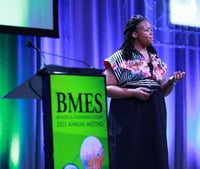
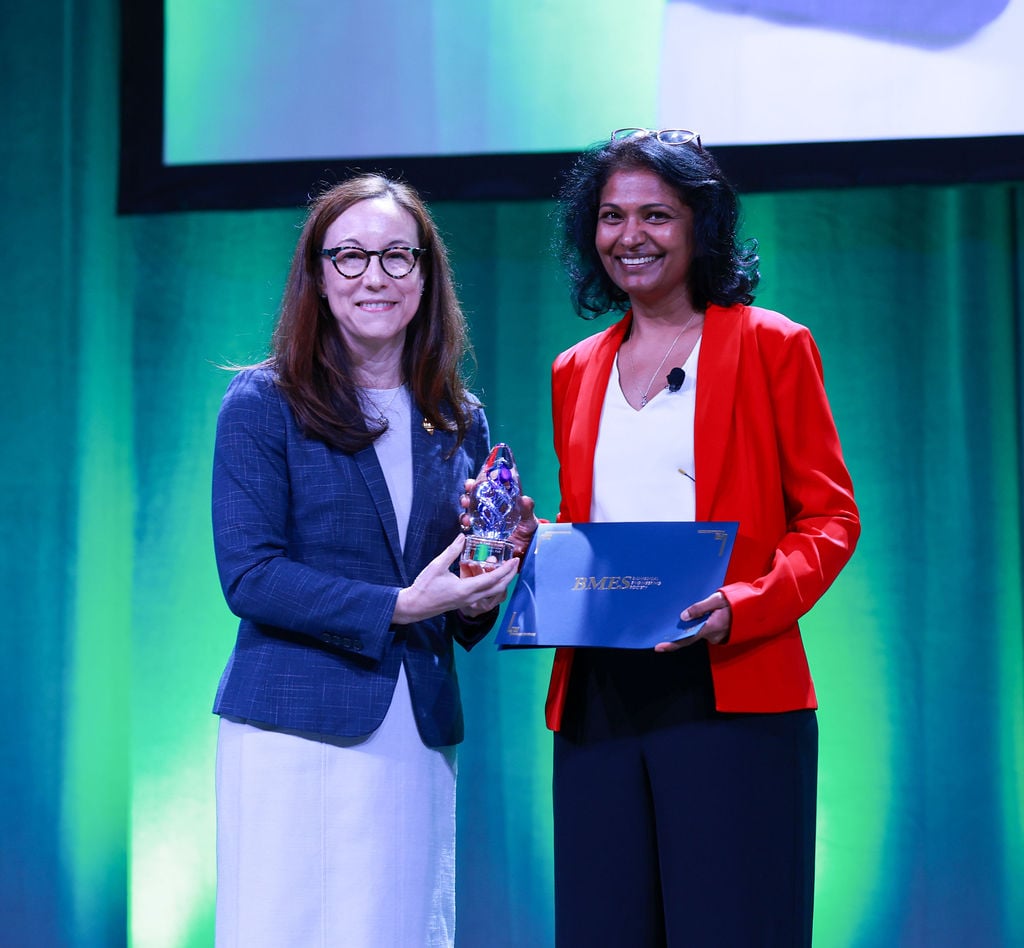
Her commitment to making engineering accessible is what earned her the Social Impact Award at the 2025 BMES Annual Meeting in San Diego, Calif.
Inspired by both of her parents’ involvement in their communities, her involvement in community began early in life.
Her father served as a Boy Scouts troop leader, HOA president, and later as a member of both the town’s Board of Trustees and school board. Her mother, a high school associate principal who led a night program, took a similarly hands-on approach, asking simple questions like “What do these students need to succeed, and how can we make it happen?”
That perspective led to night program graduation rates exceeding those of the day. She also addressed challenges like food insecurity by partnering with local businesses to provide meals to students.
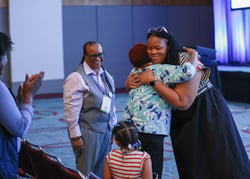 Grounded by her parents’ example, Imoukhuede carries the same rootedness in community into her own work.
“You find out what people need, and if you have the ability to help, you do that in your work,” said Imoukhuede. “It's not a career, it’s not just about you doing what you want for your life. It's ‘how do we help one another in the midst of what we're doing?’ It's just embedded in the culture that I was raised in, and in my family.”
Imoukhuede likes to ask tough questions and rely on data to evaluate results. She recalls work she did in collaboration with Dr. Kelly Cross at the Georgia Institute of Technology where they surveyed women across engineering and identified several roadblocks to their success. Specifically, women of color within that subset identified things such as microaggressions and depression as some of the challenges they were facing. Quickly bringing this information to the College of Engineering at the University of Illinois, Urbana-Champaign, it was decided to provide counseling support.
“We have people who know the problems, they know the solutions. I think it's a great chance for engineers to be a part of that solution process,” she said.
Noting that while she was already focused on maternal health research, going through pregnancy and preeclampsia herself reinforced the urgency and importance of her work. Influenced early by trailblazers like her undergraduate BME advisor, Linda Griffith at MIT, Imoukhuede has long prioritized high-impact problems, believing that more effort should go toward challenges where it can make the greatest difference.
“Let's not focus on the ones that are easily solved. Let's focus on where our efforts could really make a difference in survival,” she said.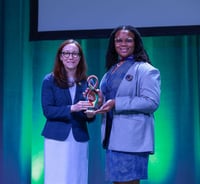
As she looks to the future, she hopes for a world where everyone can see and understand biomedical engineering regardless of their background.
“The more we focus on building community, finding ways that we come together, I think the better we are at finding the solutions we need to get through… that's where innovation truly lies,” she said.
There are opportunities for the communities to come together and support not only one another but also those external to the field, she said. “Buy the building, renovate it and make sure everyone gets the keys.”
Princess Imoukhuede delivered her lecture, “First Principles: How We Truly Measure Success in Biomedical Engineering,” at the 2025 BMES Annual Meeting in October 2025. Watch the lecture here.
For more information about the Social Impact Award, visit bmes.org/awards/social-impact.
Explore the work highlighted in this article:
The Double Bind of Race and Gender: A Look into the Experiences of Women of Color in Engineering
Intersecting Identities of Women in Engineering
The Pieces of Me: The Double Bind of Race and Gender in Engineering

This year, the BMES Board of Directors is honored to welcome 13 new members to the ranks of BMES Fellows. The Fellow grade of membership is a...
Each year, the Each year, BMES recognizes outstanding achievements and contributions of those in the field of biomedical engineering. Each winner...
%20(2).png)
A tight election for Board seats among an impressive slate of candidates vying for six volunteer leadership positions yielded the following results....

1 min read
BMES is now accepting applications for members interested in serving on a BMES Committee and/or as a member of the Medical Devices Special Interest...
1 min read
In the biomedical engineering ecosystem, breakthroughs often begin in the lab but getting them to patients is a complex journey. That is where...

1 min read
The Biomedical Engineering Society (BMES) is devoted to developing and utilizing biomedical engineering to improve health and well-being for all...