From Lab Concept to Patient Impact: Gargi Maheshwari on Translating Science into Real-World Solutions
In the biomedical engineering ecosystem, breakthroughs often begin in the lab but getting them to patients is a complex journey. That is where...
2 min read
For Buddy Ratner, BMES Member and Professor of Bioengineering and Chemical Engineering at the University of Washington, translational bioengineering has never been about commercialization for its own sake. It has always been about patients.
"It [translation] means ultimately addressing patient outcomes, making things better for patients. That's what it's all about,” said Ratner. “It's not about commercialization. It's not about making money. Those things happen. What it's really about is, how do we get things to patients?”
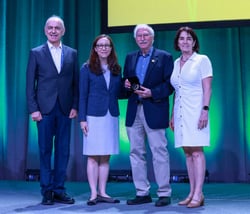 That belief shaped decades of work at the intersection of engineering, medicine, and innovation and is what earned him the Athanasiou Medal for Excellence in Translational Bioengineering at the 2025 BMES Annual Meeting in San Diego, Calif.
With over 50 years of experience, Ratner recalls always wanting to wear multiple hats as both an educator and scientist.
However, in 1996, the University of Washington Engineered Biomaterials, (UWEB) was founded as a National Science Foundation Engineering Research Center where they also received 11 years of funding from NSF. With Ratner at the helm, he suddenly found himself director of a large center with an NSF mandate of working closely with industry.
Ratner wasted no time, recalling that there were about 60 different medical device companies partnering with the Center. He also had an industry advisory board where he showcased the early-stage technologies the Center developed with the hope that companies were interested in licensing.
“At the advisory board meeting, they came back to me and said, these are really early-stage technologies. Big companies don't typically invest in certain early-stage technologies,” said Ratner. “They said, these are almost exactly the words, ‘why don't you start a startup company, bring it further along commercialization? If things look good, we'll buy your company for way more money than we would give you now to license it.’”
This advice kick started several startup companies, which was quite unheard of at the time. Ratner noted that it was an ongoing struggle on both sides, between NSF and the University of Washington, because his approach was not part of the institutional culture at the time.
Times have changed, though. Ratner now teaches a graduate level class called the “Landscape of Biomedical Technology Commercialization” where he brings in experienced industry professionals to talk about the real issues these students may one day face as he did back in the 90s.
"Some of the things that come up are to keep it simple. Simple ideas can be implemented relatively easily and have a high chance of success,” said Ratner. “Also identify a need. If there's a very substantial need, this can address something that is not being addressed in the market, then there is a big customer base. For this, those ideas work.”
As institutional culture has shifted to create a more welcoming space for industry, Ratner also noted that BMES has evolved to welcome the mechanism of translation.
“If you pulled out a BMES program from 10 years ago, you wouldn't find almost any of this [translation],” said Ratner. “BMES has come around to appreciate the importance of the startup mindset, the importance of protecting intellectual property, and a number of major identifying needs. These are all things that have been increasing at BMES.”
Ratner’s observation highlights a broader shift within biomedical engineering, one that extends beyond a single society or institution. Embracing translation requires rethinking how ideas move from lab to impact and remaining open to new directions as the needs of patients, industry, and academia evolve. Ratner’s reflection of his ability to adapt to the ever-changing engineering ecosystem is key in why he won the 2025 BMES Athanasiou Medal of Excellence in Translational Bioengineering.
"The [translational] excellence that typified by awards like the Athanasiou Medal, I think, it's doing something new, making impact. It's getting things to patients,” said Ratner. “I think these three ideas might be central, and I'm proud of what we've done there.”
Buddy Ratner delivered his lecture, “Translating Translation into the Language of Bioengineering,” at the 2025 BMES Annual Meeting on Friday, October 10, at 1:00 PM. The lecture is now available to stream.
For more information about the BMES Athanasiou Medal of Excellence in Translational Bioengineering, visit bmes.org/awards/athanasiouaward.
In the biomedical engineering ecosystem, breakthroughs often begin in the lab but getting them to patients is a complex journey. That is where...
.png)
William Wagner is the Berenfield Endowed Chair of Bioengineering and Distinguished Professor of Bioengineering, Surgery, and Chemical Engineering at...
Want to make an impact? As a CDR reviewer, you’ll evaluate submissions from student chapters and help determine which ones deserve top recognition....

Each year, the BMES Awards programrecognizes outstanding achievements and contributions of those in the field of biomedical engineering. Each winner...
1 min read
Each year, theBMES Awards programrecognizes outstanding achievements and contributions of those in the field of biomedical engineering. Each...