
Announcing the 2026 BMES Grade of Fellow Class
This year, the BMES Board of Directors is honored to welcome 13 new members to the ranks of BMES Fellows. The Fellow grade of membership is a...
4 min read
For Stacey Finley, PhD, Professor of Biomedical Engineering and Quantitative & Computational Biology and the inaugural holder of the Nicole A. and Thuan Q. Pham Professorship at the University of Southern California, mathematical oncology addresses some of cancer research’s most complex questions through quantitative tools.
“I think we can all appreciate the importance of understanding how cancer progresses, how tumors respond to treatment,” Finley said. “Having a mathematical model of a tumor helps us to answer really important questions about how the tumor grows and how it responds to treatment and how every patient's tumor has a different response to treatment.”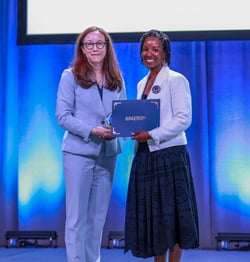
Using mathematical models is part of what earned Finley the 2025 BMES Mid-Career Award at the BMES Annual Meeting in San Diego, Calif. However, her path to the recognition began long before 2025; shaped by an early interest in engineering, a commitment to mentorship, and an evolving understanding of what meaningful career impact looks like.
Although her degrees are in chemical engineering, the problem-solving nature of biomedical engineering has always been at the core of her work.
“I've always been an engineer at heart, and by that, I mean identifying a question and developing a solution to that question,” Finley said. “Engineers try to solve problems, and to have an impact in an area that is so significant and that touches everyone is really a big motivation for me.”
Mathematical modeling and computational analysis give her a way to answer biological questions while generating predictions that others test.
“We want to develop a model that's realistic, that matches our current understanding and matches current data that we have and then use it to generate new predictions that could then be tested experimentally,” she said.
Finley notes that early career researchers often work toward a recognizable set of milestones, but as her career has progressed, her understanding of what it means to succeed has transformed.
“As an assistant professor, there are clear metrics that people use to evaluate your success and to characterize your career trajectory,” she said. “That includes publishing papers and getting external funding and then graduating students.”
Reaching those milestones eventually gave Finley room to broaden the type of career she wanted.
“Intellectual impact is more than just a collection of papers. I want to establish a body of knowledge, and I want to be able to impact the field,” she said.
That impact includes helping researchers see mathematical modeling as a practical tool for navigating cancer’s complexity and helping her trainees develop the kind of computational thinking that they can carry throughout their careers.
“The metric of success for me now is for people to start to see mathematical modeling as a tool to answer these questions. Going beyond just the papers that I publish, the trainees that come into my lab and the computational thinking that they can establish and build up are metrics of success as well,” she said.
In training her students, she’s found that mentorship plays a significant role in where she’s seen her career shift. Finley believes a mentor cannot take the same approach with every student.
“Good mentorship for me is recognizing that the mentor that I need to be is personalized and tailored to the mentee, so that means understanding their career aspirations, understanding what motivates them, and understanding how to communicate with them in a way that will be effective,” she said.
Finley has also learned that mentorship must extend beyond advice shared during scheduled meetings.
“Mentorship is not only giving advice and guidance but also speaking of that person, putting them up for awards and honors, and mentioning their names in places where the person is not,” she added.
For Finley, the success of her trainees has become inseparable from her own.
“I keep in touch with all of my trainees through text, through Christmas cards, through emails, because their success is mine. I want them to do well, and I'm really proud of what they've been able to accomplish.”
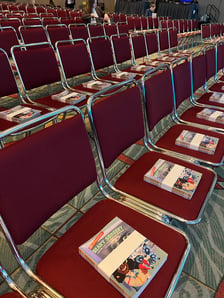 Her work expands beyond her own lab. Through USC’s Joint Educational Program, Finley contributed to a children’s book about data science in the STEAM-Powered Careers Collection. Developed in collaboration with USC scientists, faculty and staff, the collection includes 10 books introducing first- through fourth-grade students to fields including data science, engineering, oncology, nanotechnology and virtual reality. The books feature working scientists, many from communities historically underrepresented in STEAM, and are available in English and Spanish.
“My mindset is that students, especially younger students, can strive for the things that they see,” Finley said. “So, if they see an example of someone doing something that's interesting, now they says, ‘Maybe I see myself doing that as well.’”
The project took shape in 2020, during a period of national unrest. For Finley, the opportunity became a way to lean into her identity while reinforcing that science, engineering, and technology are open to everyone. She was also thinking about the importance of showing her own three children different examples of people working in science. The collection’s emphasis on representation made the opportunity feel especially meaningful for her.
“One of the missions of that initiative was to highlight STEM-related fields, and also to highlight scientists and engineers of color, both as the scientists that are featured in the book, and also in the authors as well,” she said.
For Finley, the books demonstrate how her idea of professional impact has moved beyond the traditional markers that defined the beginning of her career.
“That's more than just the paper. It's more than just the citations for your paper or a grant that comes and goes. This is a more lasting impact that could be made.”
That transformation, from measuring progress through discrete accomplishments to considering the larger body of work, was central to Finley’s Mid-Career Award lecture at the BMES Annual Meeting. Recipients of the award are recognized for significant leadership and achievement in areas of scholarship, education, mentorship, leadership, or the practice of biomedical engineering.
Finley used her lecture to trace the development of her research and walked through the questions that have shaped more than a decade of work.
“I try to give an overview of 12 years of work, and show how it's not always a linear path,” Finley said. “You start down one path, and you get an idea about something else, and you go down another path. It's not always intentional or strategic, but then you step back and you say, ‘Wow, we've learned a lot, and now this sets the foundation for our next set of questions.’”
She shared with trainees and early-career faculty the lessons she learned: remain persistent, embrace uncertainty, and approach new opportunities boldly.
“You don't know how a project will end up, but you keep going, and you sit in that uncertainty and embrace it because that's really where innovation and inspiration come from,” Finley said. “If you're motivated and inspired by it, go for it and be persistent. Keep pushing, pushing, pushing, and eventually, the external validation will come.”
Stacey Finely delivered her lecture, “Decoding the Tumor Ecosystem Through Systems Biology Modeling,” at the 2025 BMES Annual Meeting in October 2025. Watch the lecture here.

This year, the BMES Board of Directors is honored to welcome 13 new members to the ranks of BMES Fellows. The Fellow grade of membership is a...
Each year, the Each year, BMES recognizes outstanding achievements and contributions of those in the field of biomedical engineering. Each winner...
%20(2).png)
A tight election for Board seats among an impressive slate of candidates vying for six volunteer leadership positions yielded the following results....
%20(1600%20x%20700%20px)%20(3).png)
1 min read
Receiving the 2025 Rita Schaffer Young Investigator Award is a milestone many early-career biomedical engineers aspire to. For Meenal Datta, now an...

1 min read
We are seeking passionate members to join the prestigious BMES Awards and Fellows committees and play a key role in helping us recognize excellence...

2 min read
FOR IMMEDIATE RELEASE Carnegie Corporation Honors BMES Fellow Athanasiou and Other Distinguished Immigrants for Their Vital and Inspiring...