Announcing the 2026 BMES Grade of Fellow Class
This year, the BMES Board of Directors is honored to welcome 13 new members to the ranks of BMES Fellows. The Fellow grade of membership is a...
2 min read
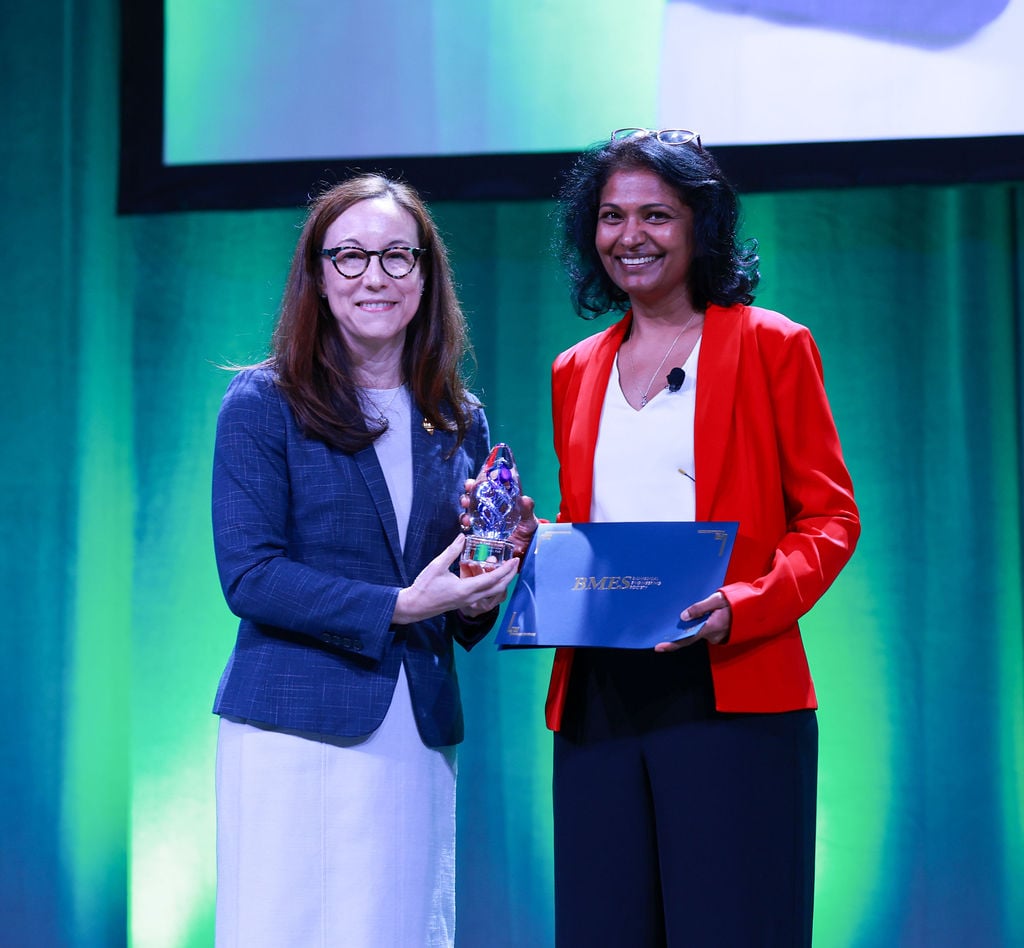
Receiving the 2025 Rita Schaffer Young Investigator Award is a milestone many early-career biomedical engineers aspire to. For Meenal Datta, now an Associate Professor in Aerospace and Mechanical Engineering at the University of Notre Dame, the recognition validated her research philosophy built on embracing collaboration, asking questions and thinking outside the proverbial box.
"I really couldn't believe that it happened," Datta said about receiving the Rita Schaefer Award. "I knew early on that this was considered the preeminent award for junior faculty in our field... I was floored to receive it."
Rethinking the science is what earned Datta the Rita Schaffer Young Investigator Award at the 2025 BMES Annual Meeting in San Diego, Calif., but her journey started long before the 2025 awards cycle.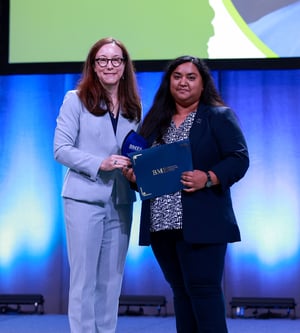
While cancer research has traditionally focused on tumor cells themselves, her TIME Lab studies a different aspect: the physical forces surrounding tumors and how they shape the body's immune response.
"People have looked at the mechanics of cancer cells in great detail," she said. "What sets my lab apart is that we're focused on the impact of those mechanics on immune cells. We're almost ignoring the cancer itself and instead we focus on everything else that's in the neighborhood."
That perspective has helped establish her laboratory as one of the first to investigate these questions in brain tumors while also exploring cancer in an unexpected research environment: space.
Ironically, Datta admits there was a time when she questioned whether she would ever develop an original research idea of her own.
"As a trainee, I was convinced that I would not come up with anything new," she recalled. "I thought the only ideas I would come up with were incremental, that I'd never be able to distinguish myself."
However, that idea changed after defending her thesis at Tufts University in 2018, based on her research in Dr. Rakesh Jain’s lab at Massachusetts General Hospital. Freed from the pressure of completing her degree, she started thinking more creatively and identifying new opportunities that would eventually expand into one of the most distinctive aspects of her research program: leveraging microgravity to better understand cancer biology.
"Whenever I have an idea, no matter how crazy it is, like sending cancer cells to space, I now think, 'No, I can do that. There's no reason that I can't.'"
This expansion of her terrestrial lab’s research onto the orbital lab that is the International Space Station was featured in a national commercial during a Notre Dame football game on NBC just a few days after Dr. Datta’s award talk, during which she played the world premiere of the commercial for the BMES audience.
While her work extends the boundaries of fundamental science, Datta and her team have never lost sight of translating discoveries into outcomes that benefit patients.
"What I think actually makes us [her lab] succeed is everybody working together and helping each other," she said. "We try to establish a common language, so that we can learn from each other."
Drawing researchers from several disciplines, she believes innovation happens when different perspectives meet.
"I believe the sum is greater than the individual parts."
Receiving the Rita Schaffer Young Investigator Award validated not only her research but the unconventional path her lab has taken. To her, the award sends a broader message about the future of biomedical engineering.
"It's not about me anymore," she said. "It's about these new people coming up, the ideas, the perspectives, the culture that they bring."
Meenal Datta delivered her lecture, “Mechano-Immunology: On Earth and in Space,” at the 2025 BMES Annual Meeting in October 2025. Watch the lecture here.

This year, the BMES Board of Directors is honored to welcome 13 new members to the ranks of BMES Fellows. The Fellow grade of membership is a...
Each year, the Each year, BMES recognizes outstanding achievements and contributions of those in the field of biomedical engineering. Each winner...
%20(2).png)
A tight election for Board seats among an impressive slate of candidates vying for six volunteer leadership positions yielded the following results....
1 min read
In the biomedical engineering ecosystem, breakthroughs often begin in the lab but getting them to patients is a complex journey. That is where...

1 min read
Did you miss early-bird pricing for the2024 BMES Annual Meeting?